
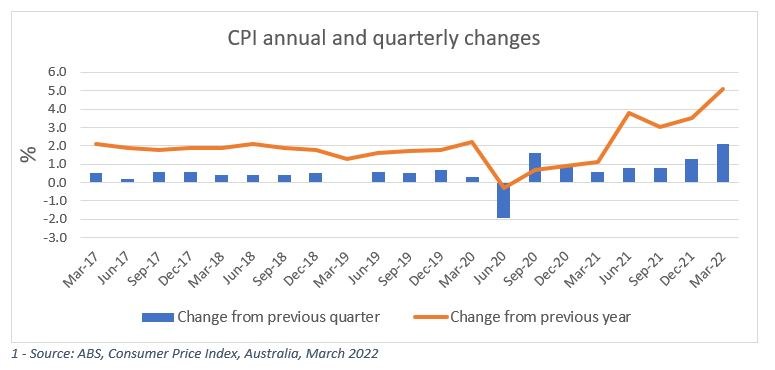
The CPI increase we saw yesterday will not surprise anyone in business over the last 18 months. With CPI recording an annual rise of 5.7% and a quarterly rise of 2.1%, we finally see businesses start to pass through the increased business costs resulting in CPI reaching a 21-year high.
Adelaide* recorded an annual CPI rise of 4.7 per cent and a quarterly rise of 1.9 per cent. SA fell below the national average along with Melbourne and Sydney, while Perth saw the most significant annual increase of 6.7 per cent.
The top two drivers of this CPI rise will come as no surprise, with automotive fuel and new dwelling purchases increasing 11.0 per cent and 5.7 per cent over the quarter.
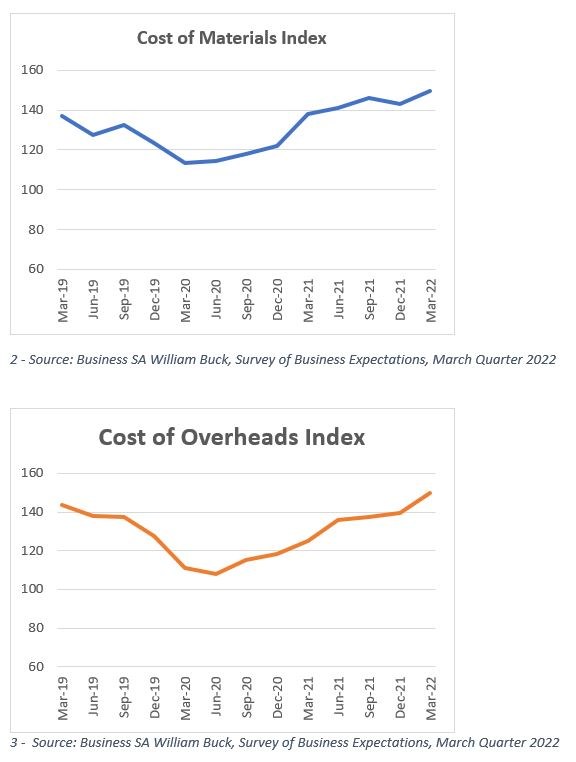
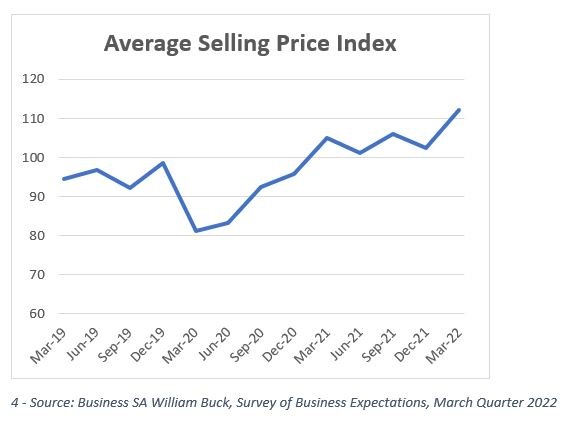
In the March quarter of the South Australian Business Chamber William Buck Survey of Business Expectations, we saw the Cost of Materials Index and Cost of Overheads Index continue to increase. This follows continuous growth since the June quarter of 2020, which is not surprising when considering the disruption to supply chains and a tight labour market. Unfortunately, businesses are coming to the point where these cost increases need to be reflected in customer prices. This can be seen in our average selling index below.
Yesterday’s release of the CPI increase will be looked at closely by decision-makers in the annual wage review. When we delve deeper into the data, there has been an increase in discretionary and non-discretionary prices of 2.7 percent and 6.6 percent respectively. Discretionary prices are those items that we can go without (eg takeaway meals, alcohol, electrics, holidays) whereas non-discretionary are those essential to our daily lives (e.g. food, shelter, healthcare).
These price increases support the argument for increasing the minimum wage. However, can businesses afford an increase at this time considering the natural wage increases currently being seen due to a tight labour market?
The RBA will also consider this at next week’s board meeting when they discuss the cash rate (currently set at 0.1 per cent). You might be asking yourself; how does inflation affect interest rates? Inflation is an indicator of how fast the economy is moving. While a fast-moving economy might sound good, it can lead to significant problems in the long run. As a result, the RBA has a target inflation rate of 2 to 3 per cent a year. Now, to combat inflation and slow the economy down, the RBA can lower and raise the cash rate to either stimulate or slow down the economy by lowering or raising the rate.
While many experts predict a rate rise by the RBA in June, yesterday’s numbers will put extra pressure on the bank to see an increase next week. In any case, major lenders have already started to put up their market rates in preparation for the rate hike.
*ABS does not measure state CPI