

Yesterday we saw the release of the latest data for the Consumer Price Index (CPI) from the Australian Bureau of Statistics (ABS). As a reminder, CPI is the price increase observed on a basket of goods and services. The June Quarter of 2022 showed that Australia’s inflation continued its upward trend. For the quarter, it showed prices rose 1.8 per cent and annually by 6.1 per cent.
At home, the results were even higher. It showed the CPI for Adelaide rose 2.1 per cent for the quarter and 6.4 per cent annually.
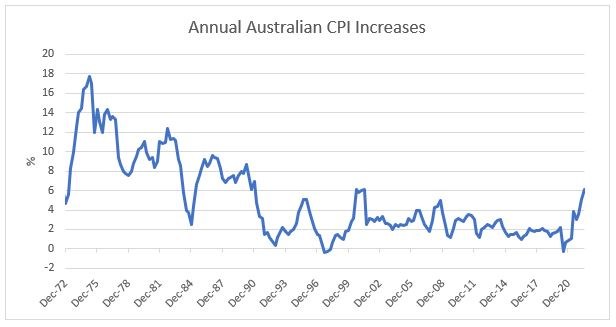
Source: ABS
Inflation has not been this high in 35 years, except in 2000 when GST was introduced which also saw a 6.1 per cent annual increase.
Today, the new Federal Treasurer, Jim Chalmers, delivered a statement on the economy to the Australian Parliament. His report outlined the Treasury’s revised forecasts for the economy.
Firstly, the good news, Australia continues to outperform the rest of the world.
Globally the outlook is bleak. The International Monetary Fund revised its global forecasts for inflation and growth. The United States is of particular concern with its cash rate rising by 75 points, and following this week’s Gross Domestic Product (GDP) figures is now in a technical recession (two quarters of negative economic growth).
But what does Treasury forecast for Australia?
We can confidently say businesses are not surprised to see the CPI number attached to cost increases they have been experiencing for quite some time.
We will release the results for the June quarter of the South Australian Business Chamber, William Buck Survey of Business Expectations next Tuesday (2 August 2022). The report shows three-quarters of businesses in the June quarter experienced significant cost increases on overheads and materials. Nearly two-thirds of businesses are forecasting further increases in the September quarter.
However, fewer than 40 per cent of businesses said they were able to pass these cost increases to the customers – so this isn’t a money grab for businesses, they are not all rushing to jack up the prices. Many are on fixed-price contracts or limited by what the market would accept.